Why Pit Zips on a Running Jacket Matter More Than They Get Credit For
Quick Answer: Pit zips address a specific ventilation problem that general jacket breathability doesn’t fully solve — the underarm area generates disproportionate heat and moisture during running due to high blood flow and limited natural airflow in that zone, and pit zips provide direct, adjustable ventilation exactly where it’s needed most, which is why their presence and design quality often affects real-run comfort more than a jacket’s general breathable-fabric marketing claims alone.
A running jacket’s general breathability rating doesn’t fully account for the underarm area’s disproportionate heat and moisture output, which is exactly the specific gap pit zips are designed to close.

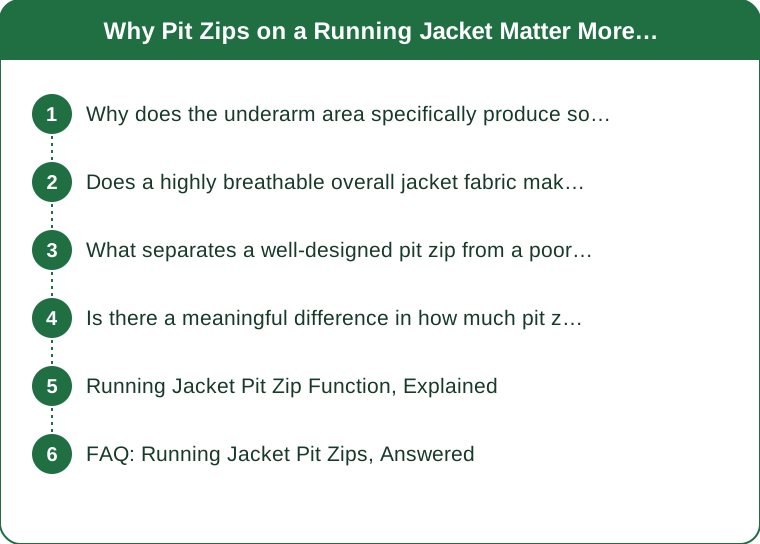
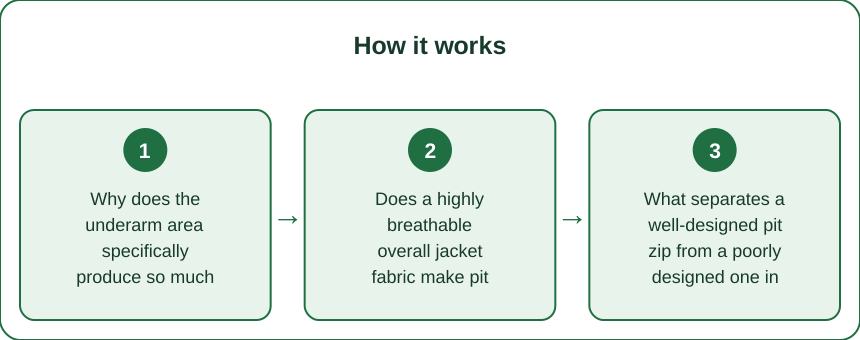
Why does the underarm area specifically produce so much more heat and moisture during a run than other jacket-covered areas?
The underarm area has a high concentration of blood vessels close to the skin surface and a relatively high sweat gland density, both contributing to disproportionate heat and moisture output compared to areas like the back or chest during sustained cardiovascular activity. This area is also naturally less exposed to airflow even during running’s arm-swinging motion, compounding the heat buildup a general breathable fabric alone doesn’t fully address.
Does a highly breathable overall jacket fabric make pit zips genuinely unnecessary, or do they still add real value?
Even a highly breathable fabric provides fairly uniform ventilation across the jacket’s surface, which doesn’t specifically address the underarm area’s disproportionately higher heat and moisture output. Pit zips provide targeted, adjustable ventilation precisely where the imbalance is greatest, offering a level of specific heat management that uniform fabric breathability alone genuinely can’t match, regardless of how advanced that fabric technology is.
What separates a well-designed pit zip from a poorly designed one in practice?
A well-designed pit zip opens wide enough to create meaningful airflow, uses a smooth, snag-resistant zipper that’s easy to operate one-handed mid-run, and is positioned to align with the body’s natural underarm curve rather than sitting awkwardly. A poorly designed pit zip that’s too short, difficult to operate while moving, or positioned imprecisely delivers much less real ventilation benefit despite technically having the feature.

Is there a meaningful difference in how much pit zips matter depending on running intensity or climate?
Yes — pit zips provide the most noticeable benefit during higher-intensity efforts or warmer, more humid conditions, where underarm heat and moisture buildup is most pronounced, while their benefit is comparatively less critical during easy-paced runs in cold, dry conditions, where overall heat generation is lower to begin with. This makes pit zips a particularly valuable feature specifically for tempo runs, warmer shoulder-season conditions, or any effort level involving sustained higher output.
Running Jacket Pit Zip Function, Explained
Pit zips work by creating a direct opening at exactly the point of highest localized heat and moisture generation, allowing that area to vent independently of the jacket’s front zipper or overall fabric breathability — this targeted, adjustable ventilation is functionally different from simply choosing a lighter or more breathable jacket overall, since it specifically compensates for the underarm area’s disproportionate output rather than relying on uniform fabric performance across the entire garment.
FAQ: Running Jacket Pit Zips, Answered
Are pit zips more important for a heavier, more insulated jacket than for a lightweight running shell?
Yes, generally — heavier or more insulated jackets trap more heat overall, making targeted ventilation like pit zips comparatively more valuable than on an already lightweight, minimally insulated shell.
Can pit zips let in unwanted rain or wind when open during precipitation?
Some pit zip designs include a small storm flap or mesh backing specifically to reduce this issue, making it worth checking that detail if running in variable weather is common.
Is it reasonable to prioritize pit zips over other jacket features when choosing a running jacket for warmer-weather training?
For runners who train through a range of temperatures and intensities, pit zips are a genuinely high-value feature worth prioritizing, particularly compared to features with more marginal real-world impact on comfort.
TL;DR:
- The underarm area generates disproportionate heat and moisture that general jacket breathability doesn’t fully address
- Pit zips provide targeted, adjustable ventilation precisely where that imbalance is greatest
- Zip width, ease of one-handed operation, and body-curve positioning separate good pit zip design from poor
- Pit zips matter most during higher-intensity efforts or warmer conditions, less so on cold, easy-paced runs
Pit zips solve a specific ventilation problem that general fabric breathability can’t fully cover, which is why their design quality is worth genuinely evaluating rather than treating as a minor afterthought feature.
Keep Reading
This article is for general informational and styling purposes only. Fit, sizing, and product availability may vary.