Why a Running Jacket That Works at Dawn Fails on the Same Run at Dusk
Quick Answer: Dawn and dusk at the same temperature are not the same conditions. At dawn the ground and air are still cooling and humidity is at its peak, so the same jacket traps more moisture. At dusk the ground is radiating stored heat and humidity is falling, so the same jacket runs warm early and then cold as the sun’s stored heat disappears. Dress for the direction the temperature is moving, not the number.
You ran at 6am in 60 degrees and the jacket was exactly right. You ran the same route at 7pm in 60 degrees and spent the first mile overheating and the last mile cold. The forecast said the same thing both times.
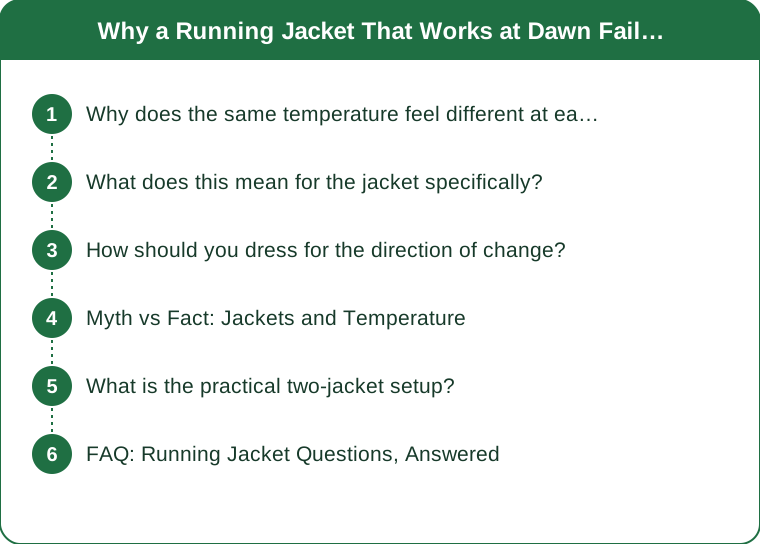
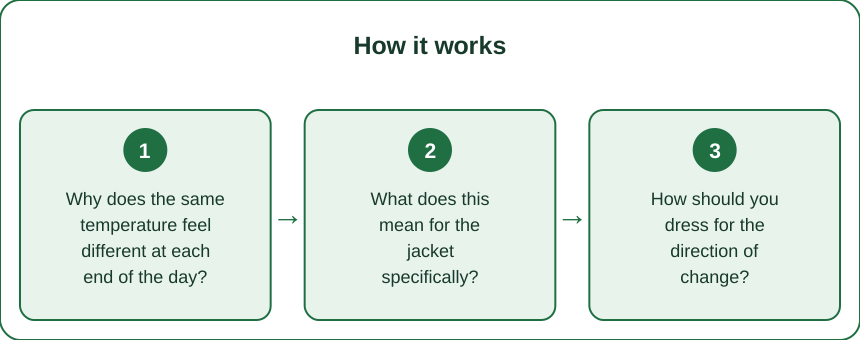
Why does the same temperature feel different at each end of the day?
Three variables move in opposite directions, and none of them is the air temperature.
Humidity peaks at dawn. Relative humidity is generally highest just before sunrise, because the air is at its coolest and holds less moisture. High humidity slows sweat evaporation, which is the mechanism your body relies on to shed heat. The same jacket over the same effort traps more moisture at dawn simply because that moisture has nowhere to go.
Ground temperature runs the opposite way. At dawn, pavement and soil are at their coldest after radiating heat all night. At dusk, they have absorbed a full day of sun and are radiating it back at you. On a city route with a lot of asphalt, that difference is substantial and it is felt at exactly the height you run at.
The direction of change matters more than the value. At dawn the temperature is rising, so you warm up over the run. At dusk it is falling, and falling fast in late August as the sun sets earlier each week. A run that starts comfortable at dusk finishes in noticeably cooler air, while a dawn run finishes in warmer air than it started.
What does this mean for the jacket specifically?
The dawn jacket and the dusk jacket have opposite requirements.
Dawn: prioritize venting over warmth. You start cold, you warm up quickly, humidity is high, and the temperature is rising throughout. The failure mode is being soaked in your own sweat by mile two and then chilled when you stop. What you want is a jacket you can open up progressively — full zip, pit zips or a back vent, cuffs you can push up. Warmth at the start can come from a layer under it that you tolerate for ten minutes.
Dusk: prioritize wind resistance and retained warmth. You start warm from stored ground heat, you cool down over the run, and by the end the air has dropped several degrees. The failure mode is finishing genuinely cold. What you want is something you can carry for the first mile and put on later — packable matters far more here than at dawn.
The practical implication is annoying and true: one jacket rarely covers both. If you run at both ends of the day, a very light wind shell for dusk and a more ventilated, slightly warmer layer for dawn covers the range better than one mid-weight jacket does at either.
A detail people miss: the hood is a bigger warmth lever than the fabric weight. Putting a hood up on a cooling dusk run adds meaningful warmth immediately and reversibly, which is exactly the property you want when conditions are moving.
How should you dress for the direction of change?
Two rules, applied opposite ways.
For a rising temperature (dawn): dress for about ten to fifteen degrees warmer than the current reading, because that is roughly the combination of the temperature rise and your own heat production once you are running. Being slightly cold for the first half mile is the correct starting condition. If you are comfortable standing outside before you start, you are overdressed.
For a falling temperature (dusk): dress for the temperature at the end of the run, not the beginning, and carry the layer for the first section. Overheating in the first mile is easy to fix by removing something. Being underdressed at mile five in falling temperatures, particularly with a sweat-soaked base layer, is not fixable.
A useful check for the dusk case specifically: what is the temperature at your expected finish time? Most forecasts give an hourly breakdown, and the drop between 7pm and 8:30pm in late August is often larger than people expect — the sun is setting earlier each week now, and once it goes the ground stops radiating.
And the sweat variable, which is the one that turns mild discomfort into being genuinely cold: a wet base layer under a wind-resistant shell in falling temperatures cools you aggressively. That combination is the actual mechanism behind finishing a dusk run shivering, and it argues for venting hard early even if the jacket is coming with you.
Myth vs Fact: Jackets and Temperature
Myth: If you know the temperature, you know how to dress. Fact: Temperature is one of four variables that matter roughly equally — humidity, wind, sun exposure, and the direction of change are the others. Two 60-degree runs can require different clothing, and usually do.
Myth: A warmer jacket is more versatile. Fact: A more ventable jacket is more versatile. You can make a well-vented jacket warmer by closing it and adding a layer. You cannot make a sealed warm jacket cooler, which means its useful range is narrower even though it handles the cold end better.
Myth: Sweat is the problem in cold conditions. Fact: Trapped sweat is the problem. Sweating is normal and necessary; the failure is a jacket that stops it evaporating and then a temperature drop that turns it into evaporative cooling on your skin at the wrong moment.
Myth: You should feel comfortable when you start. Fact: For a rising-temperature run you should feel slightly underdressed at the door. For a falling-temperature run, comfortable at the start usually means cold at the finish. Neither case has you feeling perfect at minute zero.
Myth: Dusk running is warmer because the day has been warm. Fact: Dusk running starts warmer and finishes colder. It is the run with the largest temperature swing available in a typical day, which is precisely why it is the hardest one to dress for.
What is the practical two-jacket setup?
For most people running through fall, this covers it.
Jacket 1 — the vented shell for dawn and warmer conditions:
- Full zip, ideally with pit zips or a rear vent
- Very light, minimal insulation
- The key property is that it can be opened up progressively without stopping
- Used across a wide temperature band because you are regulating with the zip rather than the fabric
Jacket 2 — the packable wind shell for dusk and cooling conditions:
- Wind-resistant, extremely light, stuffs into its own pocket or a waist belt
- Hood, which is the fastest reversible warmth adjustment available
- Carried for the first section, worn for the last
- The property that matters is that carrying it is genuinely easy, because a jacket you resent carrying gets left at home
What to wear under both: a base layer that moves moisture rather than holding it. This is more important than the jacket for the dusk case, because the wet-layer-plus-shell combination is what makes people cold.
One accessory that outperforms its size: a thin pair of gloves or a light headband, stuffed in a pocket. In falling temperatures, hands and ears register cold well before your torso does, and addressing them costs almost nothing to carry. Fixing the extremities often removes the need for the heavier jacket entirely, which is a better outcome than carrying more layer than you need.
FAQ: Running Jacket Questions, Answered
Should I just start every run cold?
For rising temperatures, yes — slightly cold at the door is the correct condition and it resolves within about half a mile. For falling temperatures, no. Starting cold on a dusk run means finishing colder, and there is no warm-up coming to fix it.
Why does the same jacket feel different on an out-and-back?
Wind direction, mostly. Running into a headwind produces significantly more convective cooling than running with it, so the return leg of an out-and-back frequently feels like a different temperature. If you can, run the first half into the wind, so the harder condition happens while you are dry and fresh.
Is a vest better than a jacket for the shoulder seasons?
Often, yes. A vest covers your core, which is where retaining heat actually matters, and leaves your arms free to shed it. For the 50 to 60 degree range with variable conditions, a wind vest over a long-sleeve base is one of the most flexible setups available and packs smaller than a full jacket.
TL;DR:
- Dawn and dusk at the same temperature differ in humidity, ground heat, and the direction the temperature is heading
- Dress for rising temperatures by starting slightly cold; dress for falling ones by planning for the finish and carrying the layer
- Ventability beats warmth for versatility — you can close a vented jacket but not open a sealed one
- A wet base layer under a shell in falling temperatures is the actual mechanism behind finishing cold
The forecast number is the least useful of the four variables that determine how a jacket performs. Dress for where the temperature is going, and the same jacket stops being unpredictable.
Keep Reading
This article is for general informational and styling purposes only. Fit, sizing, and product availability may vary.