Why a Jacket Rated for Colder Weather Than Today's Still Feels Cold at the Start of a Run
Quick Answer: A properly rated running jacket often still feels cold for the first 5-10 minutes because your body hasn’t generated enough internal heat yet at the start of a run — the jacket is doing its job of retaining heat, there just isn’t much heat yet to retain, and this initial cold feeling resolves on its own once your body warms up from the activity itself.
It’s one of the most common reasons people over-layer at the start of a run, only to overheat later.

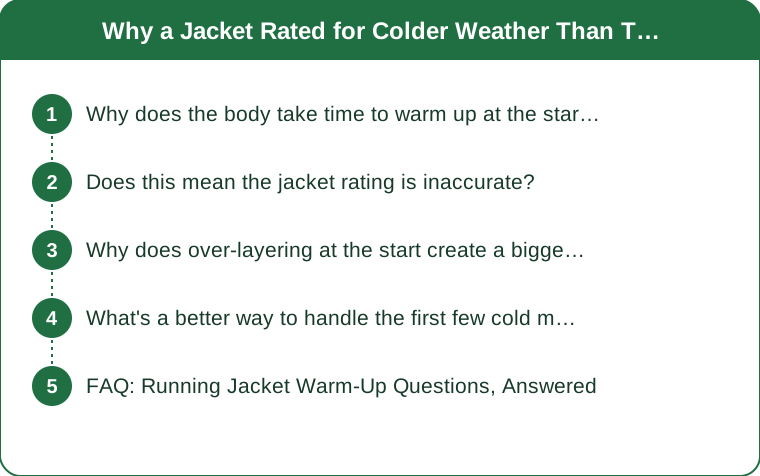
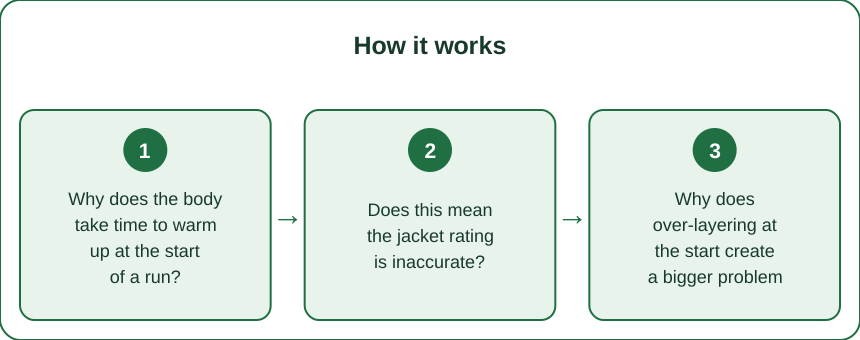
Why does the body take time to warm up at the start of a run?
Blood flow redirects to working muscles gradually as a run begins, and metabolic heat production ramps up over the first several minutes rather than instantly. The jacket can only retain heat that’s already being generated — early in a run, that heat production is still ramping up, which is why the same jacket feels different at minute 2 versus minute 15.
Does this mean the jacket rating is inaccurate?
No — jacket temperature ratings generally assume a body that’s already generating steady-state exercise heat, not the first few minutes of a cold start. The rating becomes accurate once your body’s heat output stabilizes, typically within 5-10 minutes of moderate effort.

Why does over-layering at the start create a bigger problem later?
Adding an extra layer to fix the cold-start feeling means that extra layer is still there once the body’s heat output ramps up fully, often leading to overheating and excess sweat by minute 20, which then creates its own problem (a wet, clammy jacket interior) that outlasts the original cold feeling by a wide margin.
What’s a better way to handle the first few cold minutes?
Tolerating a slightly brisk first 5-10 minutes, rather than over-layering for it, tends to balance out better across the whole run than dressing for how it feels at the start. Some runners also do a brief indoor warm-up (dynamic stretching, a few minutes of movement) before heading out specifically to close this gap.
FAQ: Running Jacket Warm-Up Questions, Answered
How many minutes of feeling cold is considered normal before it should resolve?
Most runners find it resolves within 5-10 minutes of steady effort; feeling cold well past 15 minutes may indicate the layering is genuinely insufficient for the temperature.
Does a brief indoor warm-up actually make a meaningful difference?
Yes, for some runners a few minutes of dynamic movement before heading out noticeably shortens the outdoor cold-start window by getting heat production started earlier.
Is it better to underdress slightly or dress exactly to the temperature rating?
Many experienced runners intentionally dress slightly underdressed for the actual temperature (a common rule of thumb is dressing as if it’s 10-20 degrees warmer), specifically to avoid the overheating that comes from dressing for the cold-start feeling.
TL;DR:
- A jacket feeling cold at the start of a run is about the body’s heat output, not the jacket’s rating
- Heat production ramps up over the first 5-10 minutes, and the jacket can only retain what’s already generated
- Over-layering to fix the cold start often leads to overheating and a sweat-soaked jacket later in the run
- Tolerating a brisk first few minutes, or a short indoor warm-up, usually balances out better than adding a layer
A cold first ten minutes doesn’t mean the jacket is under-rated — it means your body hasn’t caught up yet, and it usually does.
Keep Reading
This article is for general informational and styling purposes only. Fit, sizing, and product availability may vary.